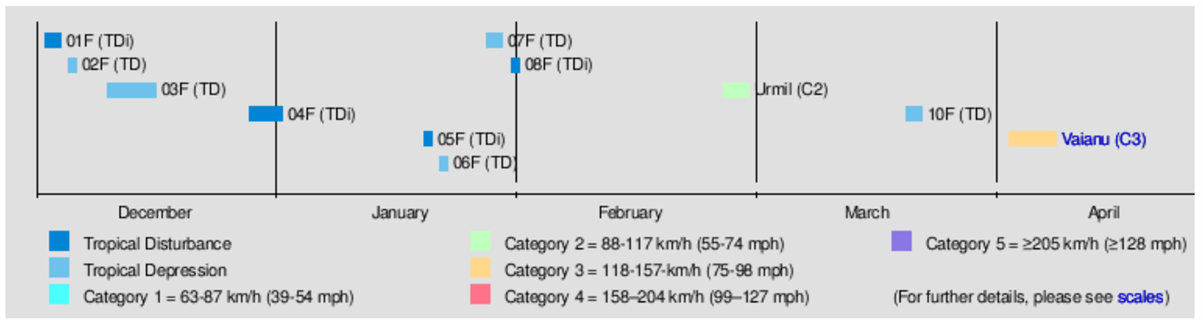
There were 11 tropical depressions, but only two developed sufficiently to be named – Cyclone Urmil and Cyclone Vaianu. So, the 2025-26 season was one of the least active on record – it tied with the 1990-91 season.
The first named feature formed in late February…. the latest start on record.
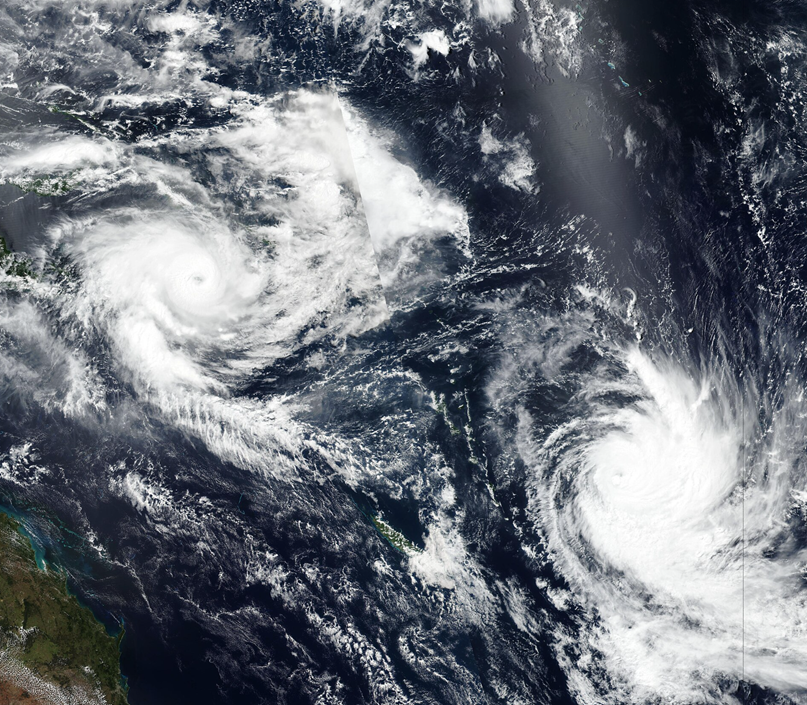
The highlight of the season was in April. Shown below are Cyclone MAILA in the Solomon Sea (west of 135E and thus outside the South Pacific basin) and Cyclone VAIANU near Fiji.

MetBob. Bob McDavitt is the weather guru that uses //etBoB to provide meteorological information for cruising sailors, primarily for those in the South Pacific.
Why so inactive?
The South Pacific Convergence zone was poorly organised, and the LA NINA climate driver has rather weak. Also, I think the stratosphere was rather windy and this tends to disrupt cyclone formation.
Madden-Julian Oscillation MJO
The MJO is a significant climate driver and helps trigger (when active) or suppress (when inactive) tropical cyclones. Its acts like a wave of extra energy that travels east from Indian to Pacific oceans.
Here is a time-longitude map of Outgoing radiation – a good proxy way to measure the MJO. Basically, OLR is high when there are few clouds, and low when it is cloudy the MJO is active. Low OLR or active MJO is shown here a blue shading:
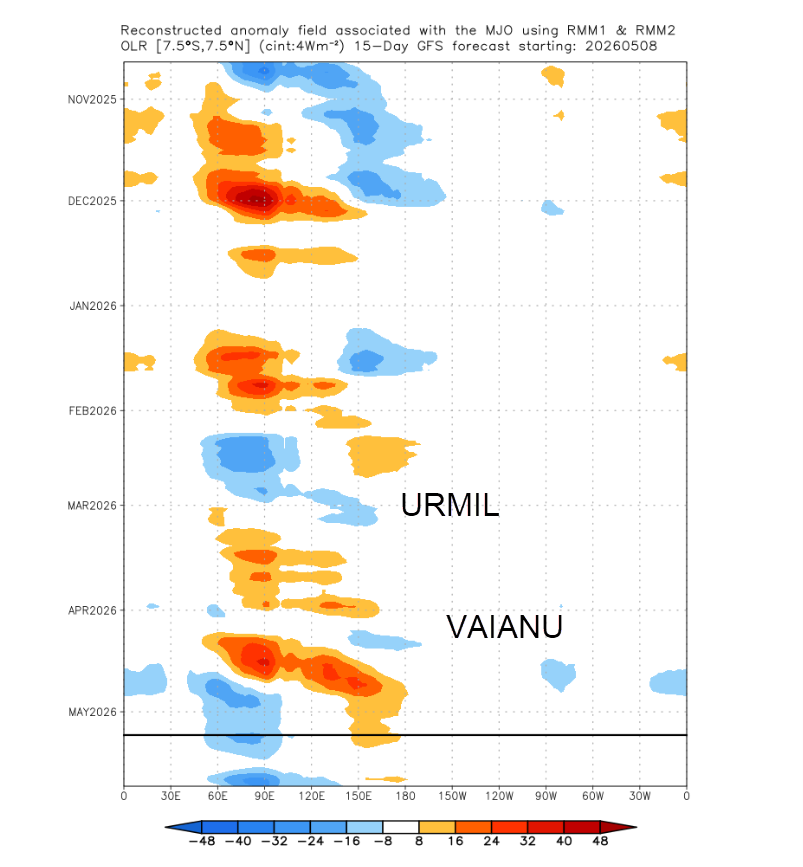
I’ve added the timing of URMIL and VAIANU to the above diagram – and yes, they seem to fit the theory that MJO can trigger cyclones.
Bob McDavitt