Welcome to another season of Daylight saving.
Our vernal (spring) equinox (Latin for equal night) was at lunchtime on Wed 23 September. That’s a special moment in the earth’s orbit, and it fittingly picked by many to mark the start of the Southern hemisphere SPRING. Daylight saving kicks in the following Sunday.
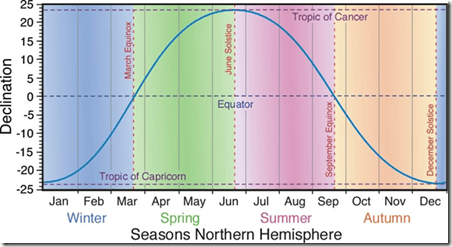
The best definition of the equinox is when the sun, as seen from earth, is directly overhead the equator.
As viewed from earth the sun is directly overhead a different latitude every day of the year. The difference between this latitude and the equator is called the sun’s declination, as all navigators know already.

MetBob. Bob McDavitt is the weather guru that uses //etBoB to provide meteorological information for cruising sailors, primarily for those in the South Pacific.
Although equinox comes from Latin for qual night, it is only a 12 hour day if you measure sunrise and sunset using the MID-POINT of the sun. Sunrise and sunset tables actually use the top limb of the sun so that, plus atmospheric refraction, adds an extra 5 to 8 minutes of (rather dull) sunlight. The name given to the day with 12 hours exactly sunlight/darkness is the equilux – in New Zealand that’s between19 and 20 Sept.
From now on the days will lengthen. But the rate is not linear—Auckland’s dawn is getting earlier at the rate of 10 minutes per week at present, but dusk is only getting later at the rate of 6 minutes per week. At the equinox the delimiter (line on the earth dividing day and night) is shaped like a square wave and during the next few months or so it slowly reshapes into a sine wave. You can watch this by downloading the program Home Planet from http://www.fourmilab.ch/homeplanet/ and watching this in the animate mode.
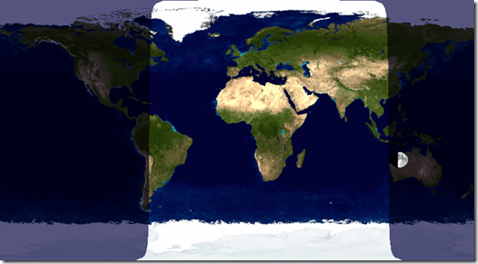
The Delimiter is a square wave at the equinox
There is a lag between the change in increasing sunlight and the spot with the warmest temperatures on earth. The lag in the ocean is a few weeks more than in the land. Currently the warmest SST band in the open part of the Pacific is at around 8 deg N.
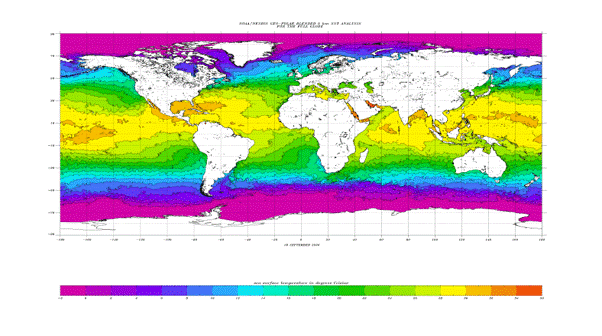
Sea surface temperatures. The warmest isotherms are coming south.
Note that the 28C isotherm in the South Pacific already extends as far as between Samoa and Fiji. It is extending southwards at a steady rate. This is the time of the year that the subtropical ridge—that zone which divides the trade winds from the roaring 40s – starts to drift southwards. As it drifts south, the isobars on its southern side may bunch closer together in places, and that increases the disturbed westerly winds in the roaring 40s. This period, known as equinoctial gales, is likely to last until mid-November. A strong El Nino encourages these gales.
Bob McDavitt