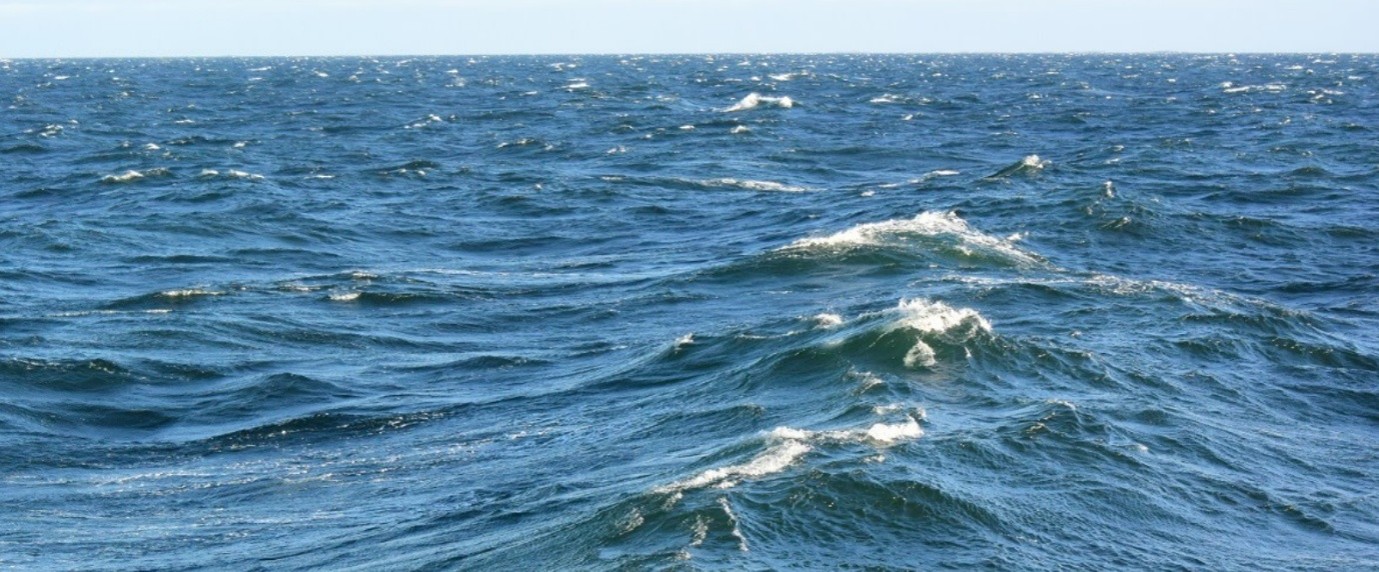
Marine forecasts give wave heights in “significant metres”.
Significant wave height (often abbreviated as Hs or Hsig is a statistical measure defined as the average height of the highest one-third (33%) of all waves occurring in a given period. This is the standard metric used by meteorologists and marine agencies for ocean and surf forecasts.

MetBob. Bob McDavitt is the weather guru that uses //etBoB to provide meteorological information for cruising sailors, primarily for those in the South Pacific.

Munk in 2010
WALTER MUNK (1917-2018) was one of the first scientists to bring statistical methods to the analysis of oceanographic data.
World War II interrupted his doctoral studies at Scripps Institution of Oceanography (Scripps) at La Jolla and led to his participation in U.S. military research efforts.
Munk developed methods for forecasting wave conditions which were used in support of beach landings such as on D Day.
In 1932, Munk was performing poorly in school because he was spending too much time skiing, so his family sent him to a boys’ preparatory school in upper New York state. In 1939 he took a summer job at Scripps, and this led to taking on a Master of Science degree at Caltech in 1940.
In 1940, Munk enlisted in the US Army then in 1941, a week before the attack on Pearl Harbor, he was assigned to US Navy Radio and Sound Lab at Scripps. Soon he and Sverdrup looked for ways to measure, report and predict wave height
In 1944 Munk wrote “Proposed uniform procedure for observing waves and interpreting instrument records”. In this he introduced the significant wave height which was intended to mathematically express the height estimated by a “trained observer”. The thing is that because an observer’s view of the waves is such that the taller waves block out the smaller, it seems that an observer’s “average” is the average of the top third.
Generally, a set of waves follows the Rayleigh distribution and the whole field can thus be determined from just the significant wave height Hs.
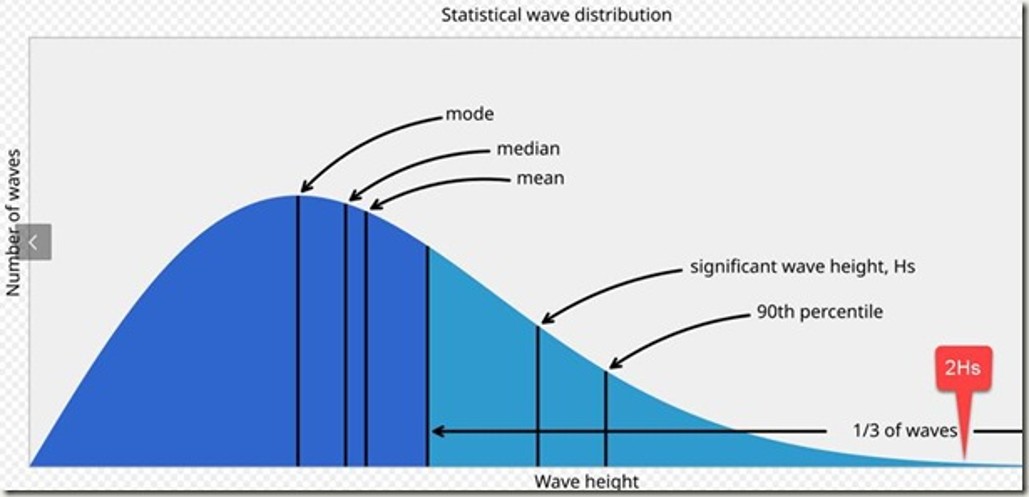
Note that the “maximum wave height” is close to TWICE the significant wave height (one such wave can be expected once a day).
1 wave in 7 (15% of all waves) is higher than Hs. And that occurs around once a minute for waves with period around 8 to 9 seconds). Hence the surfer’s rule of thumb to “wait for the 7th wave (after a lull wave)”.
Here is an interesting website for anyone wishing to experiment with interference and diffraction patterns: the ripple simulator at www.falstad.com/ripple (simulates sound, radio and microwaves but not sea waves). Click and drag the mouse to make waves.
Bob McDavitt